
34 – Using Metrics To Effectively Rate Blog Posts – Oct 25 2012

This and the posts to immediately follow are my response to the foolishness Facebook is up to, charging folks to reach all their fans.  For those who haven’t heard, they will show your posts now to only around 15% of those who like your pages, and you will have to pay, per post, to fully reach your existing audience.  At first it can be enraging news, but I think it isn’t the end of the world, in fact I think is doing everyone a favor.  Here are my reasons, and today’s idea – a solution for all those who write or read blogs.

1. Liking is more about identity than it is about desiring spam.  You like something on Facebook to show support and identify with that thing.  You do not “like” something on Facebook out of a desire for spam.  It doesn’t matter if we are talking about music, news, or most anything else.

2. The exception to rule 1 is exactly that – something exceptional.  When I want to see the news I open a news app.  When I want to hear music I fire up a music app.  I don’t want to hear random thoughts from the musician I like, but if they are playing in my area and tickets are going on sale tomorrow, THAT would be justification for a notification.  As far as news, it’s the same thing.  The top 3 news stories from today’s cycle I’m not concerned with, but if something happens that is above the cycle, like the embassy attack for instance, then I want to have that in my feed.  We are obviously all different.  Some folks do want to see an update every half hour, but that isn’t the mainstream.  It’s an automated thing we are talking about, it needs to be adjustable and balanced so that users can get what they want, and the responsibility is on the content provider.

My personal take on the issue is that unless I have something monumental to say, I’m not going to spam anyone with it.  For the record, my definition of spam is anytime my content crosses the threshold of the web in the direction of someone else.  The blogs that are complaining about the Facebook charges (some who post 10-15 times a day) are ABSOLUTELY right to complain about the charges and the principle of what is happening, but I say Facebook is doing them a huge PR favor.  You simply should not be hitting anyone else’s email, news feed, SMS or anything else 10 times a day.

3. There is no viable scale of value.  Look at your news feed.  Facebook is using comments and certain words within a post to determine a basic “value” to place certain posts higher on the news feed, but the method is unreliable as Facebook is clearly untrustworthy to promote content based on value and they would rather go the way of YouTube and just quietly start scratching the backs of those who pay up.  Payola NEVER adds value to the end result.  I do not use this “top stories” feature, as it usually just leaves posts that I’ve already seen, up to see again hours later, not to mention that in light of this new monetization racket they are pulling, the fair question of the day would have to be, “is the “most recent” listing truly now a most recent listing?”

So what is the idea in here?  The solution?  Well I come to a wonderful solution to this mischief.  For today I am going to focus on the blog issue here and I will come back to Facebook as a whole later.  Besides, I’ll need some legs in the industry before I can truly start mocking them and enjoy observing the great migration of 2013 (more on that later).  Yes, for the record, I feel that those at “the top” in any field have a responsibility to provide a continuing service which trumps their bottom line.  Facebook has been very, very naughty and by my math is laying the social world out on a silver platter to the right product.

Back to the blog issue.  Bloggers talk about all things.  Literally all things, yet the majority go unread.  Many blog sites are unable to pay out the per post Facebook charges and won’t be able to spam their product out in the future like they used to.  This means even more posts will go unread, unless something can be done.  The solution is much bigger than just blogs, and applies to all content, but to explain it simply I will just use blogs as an example.   The first part of this solution is getting an automated, valid, and recognized numerical value associated with all known blog posts.  Quite simply, a valid measure of content value can be obtained by applying algorithms to the existing metrics we already have in place for all blog posts.  Furthermore, the addition of new metrics will add further validity to the number.

An algorithm should be used along the following basic idea – blog posts would receive a mathematical “grade” or “score” by comparing various, existing metrics/measures and additional metrics/measures soon to be added.  The basic premise would be the number of shares/tweets/shows of support divided by the total number of reads.

Here is a simple comparison.

posts X and Y have 10 shares each

post X has 10 views

post Y has 20

post X obviously has more value to the average reader.

When you combine the metrics of Tweets, shares on other networks, known links from other blogs, comments (a whole week could be spent on comment metrics) you can see the various ways math can be used to provide a number that if done intelligently, would provide real value.  This is not a question of if. This is going to happen.  I’m just some guy out of the loop, painfully watching those with hands on the levers wetting themselves.

Knowing that it will happen, the next realization is that it is going to create an entire industry.  Various filter providers will put their various scores on content, most of which will occur automatically and in real time.  This would allow folks to decide who they can relate to.  In other words, a blog post gets a hypothetical “69 WordPress score” and a “45 Blogger score.”  The reader could over time look at a blog rating just like a moviegoer can relate to a particular critic’s review before going to the theater.  Finally and ideally the ultimate scenario – a user will be able to select what is important to them, (perhaps Twitter is a bigger deal to them, so the filter they set up will calculate heavy on tweets and responses and perhaps they will only want to see individual bloggers instead of big firms like TechCrunch, so the filter will specifically calculate in favor of lower views).

I have hoped for such a system of rating using obvious and already available metrics used in an intelligent way for years now.  I was very frustrated to see YouTube reject the merit value of videos in favor of simply promoting videos that contain monetization.  This was short sighted thinking on their part.  At the time I could understand.   They weren’t making a profit, and getting larger by the minute.  I wanted to give them credit for trying to at least break even, but I became less tolerant of this over time, watching the overall value of content and the overall experience reduced each day.  This is actually harmful for everyone involved: YouTube, the content providers and the users.   Perhaps if I can demonstrate an automated and effective filter for blog posts, and the money that can be made providing it, the next target is YouTube.  So I keep writing.

The next step down this blogger’s paradise rabbit hole continues in tomorrow’s post.
32-33 – The Big Flaw In Google Realtime Traffic – Oct 23-24 2012

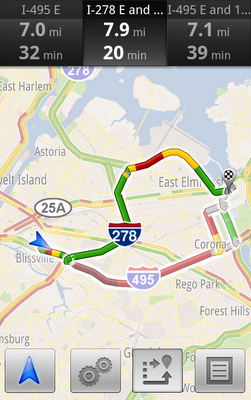
I must not be the only one to enjoy cruising at around 8 miles per hour above the speed limit, within the “tolerance” of what the highway patrol will allow before writing citations.  Since my first GPS, I greatly enjoy watching the ETA for my destination click off minute by minute as I make faster time than it’s calculation.   I have since converted to just using my Atrix 2 smartphone as my GPS, since the manufacturer of my GPS got short sighted and decided to charge for map updates.  Idiots.  So there is Google with a completely free, consistently updated product on a device I already have.

Google ingeniously just started taking in the GPS data of all connected smartphones and they were able to provide a very impressive up to the minute source of traffic information.  It is very accurate, but as I discovered over various weeks and trips of some distance, it is just not looking ahead.  It looks ahead on the road, telling you that over 100 miles away there is rush hour traffic, but it does not have the sense to look at past history and determine that  traffic is going to be gone before you arrive there.  The opposite occurs if you are an hour away from a high traffic area just before traffic begins.  You will watch in horror as your ETA starts getting block after block of 5-10 minutes added, and the route on your screen goes from solid green to yellow and then red.  As a result, it produces some wild swings, 30-60 minutes have happened to me several times, recently.

The solution is to use trends and break up areas into divisions to give an accurate calculation of traffic and what it will actually be when you get there.  It isn’t brain surgery.  First, divide the map into blocks, perhaps 5 miles by 5 miles or smaller.  The island of Manhattan is going to be heavily affected by traffic, and Cascade, Montana will not.  Once you establish where the traffic swings are and the degree to which they occur you can then assign a math value to the area as a whole, as opposed to trying to calculate and track every road in the country.

As an example of this, folks around New York City know that at 1am you can drive effortlessly across the George Washington bridge or the Lincoln Tunnel into NYC, but at 8 am, you are on a long parking lot.  There is an hourly trend, but there is also daily information.  It’s not the same on Saturday and Sunday as it is on Monday through Friday.  Daily is important, but then there is seasonal value that can be added.  There is a surge when college and school is in session, and there are a surge of people returning home at the conclusion of holiday weekends.  These are all easily tracked trends, with valuable math that can really give you trip planning.  Sure, there are abnormal construction delays and accidents, but as a rule, traffic could be easily tracked and planned for.

From this data, the next solution is adding time function to your trip planner.  Very simply, just plug in your starting and destination points and Google Maps will give you an average travel time, like it does now.  By adding the trending information, you will then be able to tell Google Maps when you plan on taking the trip and it can accurately tell you, for instance, that if you leave at 2pm on Thursday, it will take you 4 hours and 30 minutes and if you leave at 4pm on Thursday, it will take you 6 hours.
There is a difference.

So now I wait for the team of well funded engineers to think of this “amazing new feature” on their own.  🙂  Oh how I look forward to having money to toss at provisional patents in the future.

31 – Voicemail To Text Converter – Oct 22 2012

So you have called your friend, and they didn’t answer.  You know they don’t have the latest visual voicemail, and you don’t want to stick them with a voicemail, when a text is all that is needed.  There is a really simple solution for this.

You arrive at someone’s voicemail, and you hear their voice say, “please leave me a message and I’ll get back to you as soon as I can. you can also send me a text instead, by pressing 8”

“What is this?” you think to yourself, and press the 8.

Then the generic voice comes on and says, “please say your message at the tone and when you are finished, press the pound key”

You say your message, “this is Peter. if you want to hang out tonight give me a ring.” You press pound.

The computer voice then says, “here is your message” – (and then, still in the generic voice you hear he or she say) “this is Peter. if you want to hang out tonight, give me a ring. if this is correct press pound, if not, please press star.”

You press pound.

The generic voice then says, “your SMS text message has been sent”

The program converts voice to text, and then to demonstrate to you, the caller that the message is correct, it converts text back to voice, and states the message to you. This technology already exists, but as a voicemail option, it does not yet exist. I would contribute 300.00 to bring this idea to market.

30 – Automatic Call Screener – Oct 21 2012

One of the main reasons I chose to start this blog was the time stamp of my ideas that a blog like this provides.  Today’s idea stems from another idea from way back in the day, but with a twist it suddenly has new applications for today.  It was just after caller ID was brought online for everyone, and before the “do not call” list had been created.  My invention was a small box that would intercept incoming phone calls.  If the caller ID recognized the number on your list of friends / family it will just pass the call through and your phone will start ringing normally. (keep in mind, for home phone traffic, we usually have a short list that makes up 90% of all calls)  Now, if a call comes in and it is not recognized, the device will answer the phone, quietly for you on the first ring, and play the following message, “hello, the persons at this number do not accept calls for solicitation of any kind.  if you are a solicitor please hang up now.  To confirm you are not a solicitor, please press 5” (this would be a randomly generated number).   After sensing the appropriate tone, the device would then connect the outside call to the house phones and they would start to ring normally.  The residents would know that the phone ringing was not a solicitor and there would be more comfort in picking up the phone.  If the caller was to hang up or not press the correct key, then the call would be terminated and the resident would never be bothered. This whole process would occur silently.

This would eliminate nonsense calls.  For those aggressive types there would be a hotline to call and complain, and official and wide reaching complaints would be able to be leveraged against certain firms that can’t take no for an answer.  For each complaint brought against a telemarketing firm, there would be an opportunity for press coverage to this device that wars against the evil telemarketers.

That was around 20 years ago.  Another example of me taking an idea to someone I thought on the cutting edge, and they shot it down as a tough sell.  Over 10 years later it got so bad the government had to step in with a do not call list.  Another opportunity missed.  Oh well, lesson learned. Certainly in 2012, there is a smaller need for such a thing but for those with landlines, there is still a value and function to it.  It still could be easily built and sold for less than $20 and would be well worth it, but now I have a new twist for it that adds more value to all.

Looking at yesterdays idea of the voicemail system built into your phone, you could easily add this into the add as a feature.  Automated call screening with response requirements.  I still occasionally get calls from nonsense people, or bots that actually try to put me on hold when I pick up.  If they were given that same anti-telemarketer message, and required to hit a particular, randomly generated number, it would eliminate the nonsense calls and again, could all be handled quietly by the smartphone.

You could really add a host of applications to this process.  “I’m taking a nap, please leave a message, but if it’s an emergency, press 9.”  Now you can go to take an afternoon nap, turn your phone to silent and know that it won’t ring unless someone thinks it’s an emergency, and even then you can still see the call ringing and opt out of answering it.  (“i don’t care what they are going to say to me, even if they think it’s an emergency”).  The applications are many.  Eventually, the ability to press a particular key and be then connected, will be a feature offered by the carrier.  That is inevitable, but putting it right on the phone, we can make it a reality today.

29 – Voicemail Processed On Your Phone – Oct 20 2012

There is an obvious need and advantage to having your carrier handle your voicemail.  Here in 2012 we still have terrible spottiness in our cell coverage.  Voicemail allows us to provide a message to the caller we miss and also to take the message from the caller if they decide to leave one.  That’s great.  I would say without a doubt we will always want to use the carriers, freely provided voicemail, but… I think we should also have another option.  An option, provided by a simple app, that would have tremendous novelty value, and may prove invaluable in certain situations.

Voicemail on your phone.  The call comes in.  We see it, but don’t want to answer just then, or maybe we don’t want to answer that person at all.  Apples IOS 6.1 is going to allow for customizable voicemail with the carrier, so we can have specific messages for specific people, which certainly adds value, but doesn’t adapt to your specific situation at the time.  What if you could push a button, and the phone would answer for you, take the message, and store it all on your phone?  What if you could just easily retain messages this way as mp3 files on your phone?  Have you ever tried to save that certain message of your baby’s first voicemail or perhaps a special birthday message from a group of friends?  Proven the value yet?  What if you could put that caller on speaker whilst they left the message?

OK, now if you have your mind around the possibilities of this device, what if you could screen a call to send the person to voicemail, and then when you hear them perhaps confess their undying love, you have the ability to cut in and pick up the call.

Yep, sometimes it’s good to go backwards in time to take a concept forward.  The technology exists to make this a reality today, it’s just a matter of someone writing the app.  I’m in on this one for 500.

28 – Reel in Radio – Oct 19 2012

I refuse to accept the current advertisement situation on terrestrial radio.  Nearly all stations run 10-20 minutes of advertisement every hour.  This is inexcusable.

Logically, there is a value to the listeners attention.  That value is reduced proportionately to the length of advertisement.  In the end, reducing the total of advertisement is the solution to making more money.

Advertisement value is a simple equation.

Ad value = Audience + Timing + Length

Audience is the amount of people listening.
Timing is your spot in the commercial break.  The thinking is the first ad after programming is in the best position and the last ad in the commercial break is in the worst position.  The listener is more likely to turn the dial as time progresses.
Length is exactly that – the length of the commercial, but as I suggest here, it is relative.  If all ads are short, then they all have the same length value.  Only if one ad is longer than another, will it have a longer length value.

Stations try to sell as many minutes as they can get away with, only limited by what they think the average listener will tolerate.  Around the holidays or election cycles, it’s even worse.  There are many folks wanting to buy ads, and the stations figure they can get away with an increase on a temporary basis.   It’s like printing your own money.  You reduce it’s overall value with each new bill.  Looking at the above equation, for each increase in commercials sold, the value of the individual ad goes down.

The solution is to get the sales staff and the usual advertisers together for a little pow wow, where you explain that you are going to shift the standard.  You will work with them on consolidating the ads and get everyone on board with the idea.  Even if it was for a particular show, or period during the day of just 2-4 hours.  This way you wouldn’t be putting it all on the line, and people would be more willing to participate.

The example – if a station that ran 10 – 60 second ads, for a total of 10 minutes an hour, reduced those ads to 15 seconds each, and ran 2:30 in commercials an hour instead of 10:00, the only thing they would have to do is let people know that they had 1/4 of the total advertisement of the competition.   Logically it would make their station more desirable than the competitor, thereby making those shorter ads more valuable than those longer ones, playing on the other channels.  In the end, a better product for all.

27 – Craigslist and Wikipedia – examples of failed models – Oct 18 2012

It is admirable to do something for free.  It is admirable to share your ideas, services, or source code with others, for the benefit of all, but is purely irresponsible in 2012 to operate a heavily trafficked website in such a way that you must either beg for donations to stay afloat (Wikipedia), or not be able to adapt and grow (Craigslist).

Who says advertisement can’t be classy?  I say nonsense.  Advertisement can and should be monitored and regulated by the content provider.  It should be relevant to that content, for the benefit of all three parties: the content provider, the advertiser, and the web user.  Strict guidelines can and should be used to keep the site looking the way it was designed.

Non profit can absolutely involve advertisers and I intend to demonstrate this on a grand scale.  Non profits should be using ad revenue to update, grow and survive.  Let the tax records transparently show that there is a large crevasse between revenues and profits.  Let advertisers show that grabbing attention is more than just an obnoxious array of bright colors.

26 – Legal Share – Open Source Law -Oct 17 2012

(Insert lawyer joke here)

We all know there is a need for lawyers and proper representation, but as LegalZoom has proven, many of the standard filings that need to be made for agreeable divorces, provisional patents, incorporations, deeds, leases and many others are for the most part, a cookie cutter affair.  LegalZoom has brought the accessibility down nicely within everyone’s reach, and that’s great for them, but I propose it can go much further.  I propose it can be free, and it can be better.

Legal Share – Open Source Law is my solution.  It would be a website & database that anyone could select the filing they wanted in a simple form.  The site would then guide the user through basic criteria, State, values, information specific to the users needs.  The site would create a product ready to be signed and filed.  Also included would be a list of the documents used as a basis for the product created, the court address, and any information related that will help with the process.

The database will be made of legal filings submitted by individuals as well as public records.  As applicable, personal information will be removed.  The premise is simple.  Whatever you are trying to do, its already been done a thousand times.  With enough filings loaded in and categorized( much could be done automatically) a person could easily know how to handle specific issues.  Issues that LegalZoom would kick back for needing review, would be easy to find precedent for, in that users jurisdiction and all for free.

The site would run some adds and could make a killing, while still being free to all.

Sorry lawyers. Things are about to get a lot tighter.

25 – Toggle Skype – Oct 16 2012

Very simple.  Skype has it’s value, sure, but no app on your phone should be this hard to disable or enable.  You MUST be able to quit any app from within ANY window.  On the Android version you are forced to back out of 4 windows, then after selecting quit it still gives you a prompt asking about some options for the next time you startup the app. I just don’t understand the chutzpa of Skype, Facebook, and Google.  They insist upon moving forward with these various decisions IN SPITE of the majority of users being against.  Skype with the controlling software, Facebook with Timeline, Google with the blatant disregard for privacy of any kind.  These moves are the seeds of their inevitable failure.  Sure we need them now, but just as soon as there is an alternative…. Goodbye!

Alright, I digress.

The fix.  I need someone to just make a Skype toggle.  I want to see a light blue “S”.  When I tap it it should engage Skype.  When I tap it again, it should disable it.  I don’t think that’s too hard.  Put some graphic in there so I know it’s on or off as I’m tapping it. Skype already will put an icon in the top of my display to remind me it’s running, but yeah, that’s it – a basic toggle.  Just like my airplane mode, wifi, or GPS toggle.  I would chip in 100.00 to the developer if they reached out to me, and made this happen.  I have several other valuable additions I would like to see with it as well, but they are all just icing on the cake.

Anyone?

24 – Universal Automotive HVAC – Oct 15 2012

Here is a device that you could sell in the millions right in Walmart and the other box stores.  In those stores, you already have radio/music players.  One of the most popular upgrades for any car is the car stereo.   Yet we have millions of cars running around with a unit in their dash that is archaic and let’s down the car owner daily.   The standard old unit that controls their heater/air conditioner.  Knobs and levers that need consistent adjustment, and leave the driver in a state of extremes.

The solution is an LED displayed, standard sized unit that has a slim thermometer, display that looks great and keeps the temp a nice settable temperature.  At the rear of the unit, there would be several motors designed to take the control of the thermostat and apply it to the cables currently running to the rear of the controls now in your car.    Installation would be simply taking off the control you have, and installing the replacement. You would buy the unit, and just like with any radio you buy in one of the box stores these days, you pick up the adapter kit for your model of car.  DIY or have it done for you, just like with a radio, and it’s easily as important of an upgrade as getting a new stereo.