7 – Custom Starbucks Mugs – Use Iconic Brands to Connect with Fans – 28 Sept 2012

As of this posting, this is an unsponsored blog, with no corporate ties.  Still having coffee on the brain, I came up with a stellar idea for certain iconic brands to consider, and I will use Starbucks as the model.  The logo is known throughout much of the world, and it is more than likely a sacred thing, but I would think it could be to a huge benefit of customer loyalty to consider setting up a special option for fans to have their own image subtly mixed into the original image.

Image

And here is a side by side of the original Starbucks logo, and one that I made with my girl’s lovely face.  I did this in about 10 minutes on MS Paint, so that should be a testament to the low difficulty level in the concept.  I did it to give the love of my life just another example of how I see her in everything I do.  It made for a nice Facebook pic, but I immediately thought, “hey, they really could make money doing this, and it would only enhance the loyalty and recognition of the original.”

In all actuality I could set down with a programmer and in short order have a web page built that would allow users to fabricate their own personal Starbucks logo.  They could use a single picture they had, or draw it in manually if they wanted, approve it, and send to be manufactured, all without the need for any personal assistance.  I won’t even mention that certain holidays are coming that would be very conducive to the creation of such things.  Then my mind turns to the reverse of this rather subtle modification.  I have a friend who is a beer drinker, and his initials are MDG.  You could easily just modify the logo for MGD and put his name in there, instead of Miller Genuine Draft for the coolest mug, t-shirt or bar mirror a fellow could hope for.  Why not a six pack. The colors and logo make for the recognition, not necessarily the text.  It could work with the initials PBJ.  You could put any name in place of Coke or Pepsi and the logo will always make the connection for you, regardless of the name. There are plenty of ideas out there, and the concept is a winner.  Make your brand accessible and something that fans of yours can connect and identify with, and you drive more people to your product.

Negotiate with a group of companies who would rather farm the process out to someone else, and you could launch a firm that just does this.  Let’s see how long it takes for someone to pick up this idea.  🙂 Onto tomorrow’s thought.
6 – A real recyclable K-Cup solution – Sept 27 2012

To my alarm I noticed the Keurig machine at the local chain store has changed.  Now instead of the famous, iconic K-Cup they have developed some new mischief.  A non-compatible new cup style.  Honestly my first thought was that they were foolish to do such a thing.  Then I actually did some reading on the move, realized the reason behind it, and now I think they are more foolish.

I will explain.  The K-Cup is a primarily plastic cup with an aluminum foil top and a paper filter, all ingeniously sized for a single cup of coffee.  The only issue is an environmental one, and it is a legitimate issue that many have raised.  I have a Keurig machine at home, (my second) and I love it, but this morning, I cut one apart to see if I could come up with the solution.  I think I have.  Before I get into design mode, I will say that the main benefit of the naughty little cup is the freshness of it’s contents.  They are sealed individually until use.  So the coffee always tastes fresh as possible.  This is a huge advantage.  The other issue is ease of cleanup.  Keurig has a little alternative cup that you can load with coffee yourself, rinse and reuse.  It simply is a pain in the neck for most, messing about with those little grinds; trying to clean them out of that little filter screen.

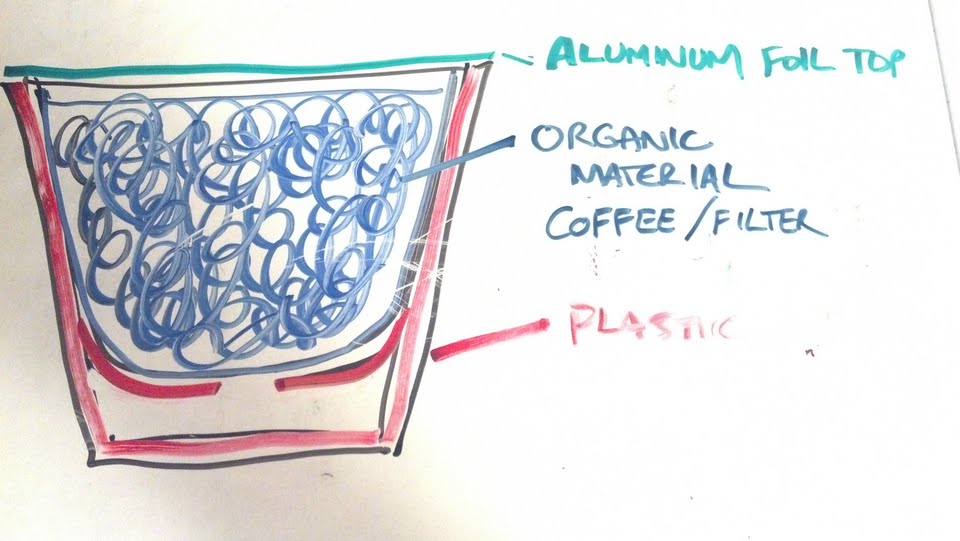
So here’s a quick sketch I did this morning of the K-Cup.

The top is the layer of aluminum (green), for freshness.
The center is the organic material (blue), specifically the coffee and the ultra thin paper filter that surrounds it.  The main part of the cup at issue is the plastic casing (red).  I sketched it this way to allow me to easier explain the Keurig solution (which involves an entirely new product line) and my own solution.

First the Keurig solution.  A whole new cup, called the “Vue” with a similar plastic assembly to what you see above, only the filter and aluminum top separate after use, and the plastic can easily be recycled in a #5 accepting facility.  (not one here in Syracuse)  Seems like a great solution, but really, it is wildly unnecessary.  Also of note, is that Keurig advises you to toss the portion of the cup that is organic WITH the aluminum seal.  Less than ideal.

My solution.  We have established we want a fresh cup of coffee, we want individual brews, and we want to easily be able to separate the plastic from the aluminum foil, from the organic material.  The solution is wildly simple, and could be made for Keurig machines without any concern for Keurig patent fees or any such thing.  The solution could be on store shelves within weeks and would be wildly cheaper, equivalent in taste, and tremendously better for the environment.  Simply sell a filter unit, pre-filled with coffee, that is just the right size to fit inside the DIY K-Cup unit Keurig already sells for the unit.  It could just be a round ball of various flavored coffee, already in a thin filter, completely easy to insert, use, and remove, and because it is entirely made of coffee and ultra thin paper, it is easy to dispose of.  (Ideally, it could be tossed right in the compost bin.)  Now, no plastic is used, so no recycling of plastic is involved.  Lastly, that pesky aluminum foil bit.  Well you want fresh coffee, yes?  Wrap the little suckers individually in an aluminum wrapper.  That would provide for your labeling, your freshness, and is far easier to recycle than #5 plastic.

Now somebody please make this happen.  I’ve gotta think of something worthwhile for tomorrow.

5 – Virtual Keyboard meets Virtual 3d Screen – Sept 26 2012

Image

These glasses are the Sony HMZT1 and provide not just sound, but a virtual 72″ 3d screen.

Image

This is the virtual keyboard, using lasers to create a virtual keyboard, and trace the movements of the hand, taking in keystroke data.  I actually did have a brief email exchange, some years back with one of the Siemens’ engineers in Germany, who was working on the initial concept development.  (that was concerning just some of the finer points on the virtual keyboard, specifically the initial calibration and setup)

The really cool stuff occurs when you look at the two of these combined, with the addition of position tracking.  The concept occurred to me a few years ago.  With the virtual keyboard you are limited to “press” the virtual keys within the confines of the laser representation of the keyboard.  Linking up the two devices would allow you to have a completely adjustable keyboard surface, colored anyway you want.  Now I will describe what I’m talking about.

The user places the keyboard on the desk surface.  With added positional tracking of the device, the computer is able to track the actual location of the keyboard surface.  Now the user puts on the glasses, and with the positional tracking of the glasses, the computer is then also able to track the actual location of the users viewpoint.

Now imagine a simple black background screen.  Using the positional tracking, you swivel your head 360 degrees, and everywhere you look is black.  Turn on the virtual keyboard, and now when you look down in the vicinity of the keyboard, a virtual representation of it appears.  You position your hands, (also represented on the screen because they are being picked up by the laser sensors built into the virtual keyboard), and the keyboard now can adjust to you.  Perhaps you just hold down your pointer fingers wherever you’d like and the computer knows this is the designated “calibration” command.  The virtual keyboard grows or shrinks and aligns itself to your fingers, and now you can just start typing.  When you look up, the computer can show you whatever you’d like.  If you need to look down again to orient yourself, you will see the virtual keyboard, existing in the field of view exactly where it is in reality.

If I get a chance I will put up some sketches of this, as I know it is a concept that some will not completely grasp either what it means visually, or what it means functionally.  I assure you, it’s mind blowing stuff.  🙂

4 – Facebook Universal – Sept 25 2012

I was using Google Translator to say something sweet to my fiance in foreign tounge and the thought came to me, “if it’s this easy to translate whole phrases, paragraphs even, then why can’t they just build this into the application as an option?”  I have Facebook friends in various countries and they do regularly talk in other languages.  What would happen to the cultural barriers if the dialect was not a factor?

A suggestion would be some manner of notifying the reader that the post has been translated.  Perhaps a small icon with a “T” for translated, or a similar thing.  Person A from one location types a caption in one language and attaches it to a pic of an amazing looking meal.  Then person B, C, and D all respond universally to the picture and are able to take in the information about it, all reading about it in different languages; perhaps ingredients or cooking methods.   They can then comment and share feedback in a language they don’t know.

The implications are far reaching.  Crisis or natural disaster in one country, can be met with support and encouragement from another.  This results in a greater understanding on both sides.  Let’s chill out about stock prices, and figuring out how to maximize mobile user advertising profits, and get back to the product.  Let’s get back to what a social network is supposed to be providing.

3 – Reasons to take the face out of the Facebook – Sept 24 2012

I work in a place where we have a program that encourages helping others through difficult situations.  It is a general help program, but is certainly geared around suicide prevention.  It is known as “wingman policy,” and we are all taught to be each others wingman.  Yet, we still have an issue with the possible penalty of even asking for any such help.  It is inevitable.  Admitting weakness, or personal problems to coworkers when every other system established puts them as your competitors, is naturally something to resist doing.

The solution, in some cases could be an anonymous system.  The main issue in enacting such a system would be a commitment to the anonymity of the program and those participating.  Users could enter an online system that would allow them an anonymous identity (truly), and then they could enter a social network of counselors, or perhaps just folks like themselves who are willing to talk, and have been vetted on the most basic dos and don’ts for the purpose of just being there for someone else.  This would be invaluable not just in situations requiring anonymity, but also in situations where geography limits what is available to a person in need, and perhaps they didn’t use Facebook.

The internet allows us connectivity that we have never had access to before.  We just need to think of more ways to use it.  With some quality oversight, an effective and far reaching program that actually brought help could be enabled and I can’t see why it wouldn’t go viral.  I mean that is Facebook’s number 1 complaint right now – their handling of everyone’s personal information.  If a community could be anonymously set up and information selectively saved, it may not be beneficial to advertisers and data-miners but it could just be better for the lot of us.

2 – Bypass hotel motion sensor thermostats – Sept 23 2012

Sounds good enough.  Empty room equals no need for AC or heat, which is true, but when you rely on motion sensors to achieve this it has one huge potential problem.  Guests don’t move much while they are sleeping.  This leads me to today’s idea.  A simple clip or stick on device that moves a small metal element side to side at programmable intervals. Place the device directly over the movement sensor and it would fool the sensor into thinking someone was moving around in the room. It would be silent, convenient, and easily could be added to any traveler’s bag.  A small battery would be all that was needed, and would last for many nights of consistent use, and keep the travelers room at the desired comfortable temperature.  It certainly would be worth it, if it keeps you from waking up in a nice warm sweat.  Ugh!

(Yes, there are other uses for such a device)

1 – Locally grown logistics – Sept 22 2012

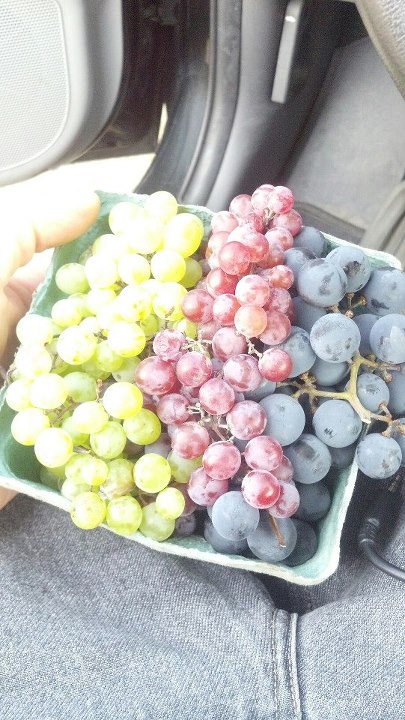
3 dollars worth of grapes from Erie, PA

Passing through Erie, PA later week, I stopped in at a local market and got a quart of mixed grapes for 3 dollars.  These weren’t harvested in California or overseas and shipped in.  They were local.  They were delicious.

As I left and continued on my journey, popping grapes like the wonderful candy that they are, I considered the problems that I saw.  Primarily an abundance of grapes, a shortage of grape buyers, and a limited shelf life.  This is the issue of locally grown, seasonal food.  Getting the bounty out in time, to a public that would love to have some, they just usually are unaware, and farming still hasn’t embraced the web as much as it needs to.

What is the solution?  Is it a once a week farmers market?  I don’t think it can be.  And, what would happen if locally grown could be encouraged, on a large scale?  Locally grown is obviously better in all regards; environmentally better, economically better, healthier and tastier for sure.  It would only have an increasing, potentially exponential change on the market of food, as more growing would equate to longer seasons, larger variety and greater consumption.

So what is the solution?  Simply, the web.  I propose a new tab on the well worn Craigslist and the addition of a delivery service, would be all that is needed to get those precious perishables out of farmers hands, and into kitchens and tummies all over the nation, in short order.

Can’t make it to the farmers market this week?  No problem – just call your order in and it can be delivered for a low fee.  Add your email to the notice list and you can be alerted in advance to things like the upcoming blackberry, sweetcorn, or apple harvest.

Now, get your local farmers selling out and making money on their crops, and you have an increase in subsequent production.  Increased growth means farmers can stagger crops and extend the time a particular item can be available, and that farmer can also grow something different.  More food, bigger variety, available longer…. yum.  And those folks with the greenhouses – they can grow all kinds of crazy stuff.  There just has to be equity in it for them.

Somebody needs to take this and run it on a national level.  It needs to be free.  There is too much to be gained for us all in its successful use.  A central site should eventually arise with all links for everyone in the chain, geared towards the local folks.  It should include links to recipes, and substitutions, so folks can use as much local stuff as possible.  Keep the government out of it.  Keep some large corporation out of it.

The internet has infinite potential.  This is just one of the thousands of examples.  I hope we can make this happen.

>follow up
Yes, after posting I did the Google search and found some facsimiles of the concept out there.  As I say in my original post, this is fine with me.  Oftentimes, my ideas will come in things I am unfamiliar with, and seeing people doing things that match up with a knee jerk thought I came up with, just reinforces that it was a good idea.

That being said, I noticed no free service.  Some folks charging 3% for “hosting” fees.  Silly, really.  Free is the only way to get massive growth, and really make money.  Trying to profit out of the gate just slows you down to such a degree that you can rest assured someone else will execute the move better and drive you out before you make any big money.  Also, the delivery service I found always seemed to be a grower provided thing.  This is too limiting, as your customers may want various items, but rest assured they don’t want 18 farmers delivering things at various times throughout the week.  There should be a central delivery service in each locality, that can work with all growers, providing perhaps even a daily provision.  It is the advantage of convenience and availability that the big grocery store has on the local folks, and only with a centralized delivery service, and eventually an actual, maintained storefront will that be comparable.  It will never be a typical grocery store type of thing, I am envisioning more of a hub.  It has to be centralized and comfortable for the shopper.  The problem I see is there being no option for a person who just wants a few items on any particular day to have something locally grown.  Could it happen today, no, but over time, as the market share of locally grown starts to increase to a level where the mainstream is interested, it does become a feasible option.

Make no mistake, it’s in Walmart’s best interest for the small guys to carry on like a bunch of individuals, and we all know where that leads.  Bland-sauce!