
I must not be the only one to enjoy cruising at around 8 miles per hour above the speed limit, within the “tolerance” of what the highway patrol will allow before writing citations. Since my first GPS, I greatly enjoy watching the ETA for my destination click off minute by minute as I make faster time than it’s calculation. I have since converted to just using my Atrix 2 smartphone as my GPS, since the manufacturer of my GPS got short sighted and decided to charge for map updates. Idiots. So there is Google with a completely free, consistently updated product on a device I already have.
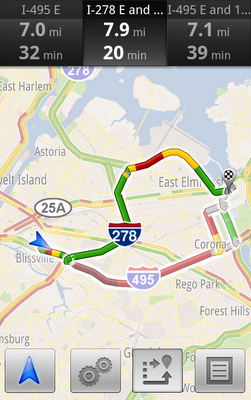
Google ingeniously just started taking in the GPS data of all connected smartphones and they were able to provide a very impressive up to the minute source of traffic information. It is very accurate, but as I discovered over various weeks and trips of some distance, it is just not looking ahead. It looks ahead on the road, telling you that over 100 miles away there is rush hour traffic, but it does not have the sense to look at past history and determine that traffic is going to be gone before you arrive there. The opposite occurs if you are an hour away from a high traffic area just before traffic begins. You will watch in horror as your ETA starts getting block after block of 5-10 minutes added, and the route on your screen goes from solid green to yellow and then red. As a result, it produces some wild swings, 30-60 minutes have happened to me several times, recently.
The solution is to use trends and break up areas into divisions to give an accurate calculation of traffic and what it will actually be when you get there. It isn’t brain surgery. First, divide the map into blocks, perhaps 5 miles by 5 miles or smaller. The island of Manhattan is going to be heavily affected by traffic, and Cascade, Montana will not. Once you establish where the traffic swings are and the degree to which they occur you can then assign a math value to the area as a whole, as opposed to trying to calculate and track every road in the country.
As an example of this, folks around New York City know that at 1am you can drive effortlessly across the George Washington bridge or the Lincoln Tunnel into NYC, but at 8 am, you are on a long parking lot. There is an hourly trend, but there is also daily information. It’s not the same on Saturday and Sunday as it is on Monday through Friday. Daily is important, but then there is seasonal value that can be added. There is a surge when college and school is in session, and there are a surge of people returning home at the conclusion of holiday weekends. These are all easily tracked trends, with valuable math that can really give you trip planning. Sure, there are abnormal construction delays and accidents, but as a rule, traffic could be easily tracked and planned for.
From this data, the next solution is adding time function to your trip planner. Very simply, just plug in your starting and destination points and Google Maps will give you an average travel time, like it does now. By adding the trending information, you will then be able to tell Google Maps when you plan on taking the trip and it can accurately tell you, for instance, that if you leave at 2pm on Thursday, it will take you 4 hours and 30 minutes and if you leave at 4pm on Thursday, it will take you 6 hours.
There is a difference.
So now I wait for the team of well funded engineers to think of this “amazing new feature” on their own. 🙂 Oh how I look forward to having money to toss at provisional patents in the future.
 100 Good Ideas