
40 – The Next Operating System Will Include Self Regulation (And Vital Organs?) – Oct 30 2012

The problem with these damned machines we use, is that they don’t have basic common sense when it comes to self preservation.  Viruses can easily be written to tell a PC to simply harm itself in one way or another.  Any protection you write into the code, can be violated in some way.  The virus basically tells the operating system, “hey, I’m actually a valid process, and you are cool with this modification I’m making to this important system file.”  The operating system is truly incapable of saying, “hey wait a minute, i can’t let you do that!”  Sure virus protection works well when employed aggressively and updated religiously, but there are always exceptions where the program is fooled into some wrongdoing upon itself.  To put it in terms of something more physical, if you had a robot, it would be the equivalent of that robot pulling out a screwdriver with it’s right hand and stabbing itself in the eye socket.  Is the robot not capable of basic common sense?  “No matter what I do, I know that I should never stab myself in the eye with a screwdriver!”  That is a humorous visual, but it begs the question, “can this stupid computer not be programmed to just flat out not harm itself, no matter what command is input or line of code seems to demand.

I have spoken with a couple programmers and they all say the same thing.  Whatever you write in there for the program to do or not do, there could easily be a hack written to simply modify that rule or rules and have the program doing bad things to itself in no time.  The “rules” of the code are constantly subject to change. So I say BS.

One thing I have learned is that if a hacker or group of hackers wants to have there way with you, there is really nothing you can do, outside of government level protection, that can save you from harm.  Put it another way, if someone has to come into your home and pull your laptop out and throwing it into the river, you can never be 100% safe.  So what is the best advice.  Be the wolverine.  Be the honey badger.  These two animals are certainly not the biggest, not the strongest.  A bear could surely eat one if he wanted to badly enough, but the bear knows that the meal will be the most painful meal of it’s life.  Just not worth it.  So the answer with protecting yourself online, is put enough protection on your machines that it may be “possible” for your machine to be hacked or attacked, but it will just not be worth the trouble.

So how is this done?  The non-programmer proposes two things.  First, all processes carried out by the operating system, (the brain of what the computer is actually doing), will be broken into 2 tiers.  Tier one is the sacred system.  The “vital organs” of the operating system.  Files that if modified, will have significant harm on operations, for example. Tier two is the various programs or settings that the user and the programs used have access to, just like they do now in the operating systems of today.

Secondly, the operating system will enable a virtual regulator that will run an encrypted code sequence against any action to modify the “vital organs” of the operating system and it’s sacred operations and files.  This technology exists already in encrypted emails as your identity is verified as the sender and intended recipient, and also to prove that the message is intact down the line.  This method would just be used within the operating system with certain absolute functions that can’t simply be circumvented.  Updates from the operating system, could on a quarterly or annual basis, include new encrypted keys to ensure that there violation would again, not be necessarily impossible, but just extremely difficult, and just not worth the trouble.

Again, I am not a programmer.  I hire the programmer.  I envy and respect the programmer, but I am not one.  I just know it’s high time we get start keeping these machines from stabbing each other in the eye with the proverbial screwdrivers that are out there.
39 – Facebook’s Next News Feed View – Categorical – Oct 29 2012

Currently Facebook offers “most recent” and “top stories” options for the news feed.  These are fine for now, but we need to get on to the next level.  Ideally that would be “by category.”  That’s right, certain keywords and phrases would cause linking within the news feed during a given period of time and users could see not just a dinner pic, a meme, a inspirational note, a hurricane update, one after the other.  Instead they could see the most recent 4-6 of each together.  Now, by putting them together, there would not be a need for each one taking up half of your news feed space.  4-6 dinner pictures could be placed in your news feed as a block, with the friends name and the first 5 words from the description under each one, or perhaps expanding out with a “mouse over” like what happens now when you hold the mouse over a commenter’s thumbnail.  The fact is, then you are browsing images, you very quickly can see what interests you and what doesn’t.  Memes, religious images, and political images are all examples of things you may or may not be in the mood for.  If images could be automatically categorized, which we now have the technology to do quickly and easily, the overall experience of the news feed browse would be quite possibly, a manageable event.  Currently many just don’t have the time to go through all the posts that were put up since the last time they visited.  That is a recipe for disconnection and apathy.  Categories – that’s the remedy.

If I haven’t sold you yet on the obvious value to this concept for every Facebook user, then just consider the obvious follow on thought.  With this categorization, the user will be able to just select a particular category and go through that specific portion of the news feed.  Oh yeah.  Still not sold?  Just consider the opposite.  Consider being able to prohibit that particular portion of the news feed;  like all political posts, all religious or all atheist posts (or both), or pics containing particular words.

What crazy nonsense is this?  A news feed catered just the way I want, with only information I want to see?  Who would be interested in that?

38 – Commenting Billboard – Oct 28 2012

Be it YouTube, Facebook, Imgur or whatever site you can think of that has open commenting, there should be a daily top 10 comments listed somewhere on the page.  At it’s simplest it can be an automated product based on the likes or likes vs dislikes.  Now before you cry out that this is trivial and of no importance, please consider the possibility that commenting, in general, can be have a very positive effect on ones writing skills.   As we all know, grammar and spelling errors are corrected instantly by the technically accurate trolls who seem to lie in wait, but I would say without a doubt, regular commenters who actually take in the feedback of others, are improving both their brevity as well as the relevance of their writing.   A top 10 list of the days most favorably responded to comments from all the posts within any of the big sites would be at the least a valuable read.

On a technical note, privacy could be preserved.  YouTube, not an issue as it’s all open, but Facebook could prompt the user, “You have one of the top 10 comments in Facebook today.  Click “everyone” now, to share this comment, and the original post with the Facebook community.”  This could be done for the original post as well, if applicable.  If the person with the original picture or post is not interested in sharing, then the computer just goes down the list to the next top rated comment.  Again, it would be completely automated.  The website owner would be allowing the users to generate additional content for their benefit and enjoyment, and yet another thing to come back to.

37 – Content Connections Made By Connecting Comments – Oct 27 2012

Perhaps the simplest solution to explain yet.  Connections could and should be made by the content of the comments section.  This applies to all content, and could simply be used in the background with the existing “related content” algorithm or be listed transparently to the user – “based on the comments in this post, you may also be interested in the following posts.”  This is a connection I have not seen anyone pick up on yet, and I just came to mind today as I was driving along on Interstate 81.

The really cool stuff happens when you place these associations into the appropriate analysis.  For example, trends could be determined from groups of conversations without having to use polls, as well as other useful determinations.  (Some of this goes back to my post on English as Math as the computer is better able to understand a value in what is being said.)  Sorry, Facebook.  Instead of patting yourself on the back for the addition of “5 friends posted about President Obama,”  it would be much more impressive to see, “among your friends, 37 thought he won the debate, 38 thought Mitt Romney won, and 13 thought it was even.  among your friends of friends it was 284 / 274 / 69.  That determined in the comments of the following 45 threads.”  Or perhaps, “the current hot debate on last nights game, with currently 58 expletives and counting, is at this thread.”

Oh geez, what am I saying?  Facebook can’t even include a dislike button.  (Thumbs down)

35 – Blog Aggregate = Bloggers Paradise – Oct 26 2012

Regardless of your political standing, if you appreciate getting the most recent news stories in one location, you must appreciate the Drudge Report model.  If you are unfamiliar then you should stop reading immediately and see for yourself.  If you hate all things conservative and it blocks your brain from being able to appreciate ingenuity there is always the Drudge Retort, but the concept of aggregating news using links that Matt Drudge started is revolutionary and has changed the face of news.  Period.  Today’s solution is simply the combination of yesterday’s post on automated blog “scoring” and the use of blog categorizing to create a instantaneous bloggers paradise.

Let’s just call it blogaggregate.com for the purpose of discussion.

You arrive there, and the hottest blog posts of the day are listed, some with included pics, all having been high scoring and all on various topics.  Now just type any word into the search bar.  The result is a page full of the top related blog posts.  Highly rated posts are elevated to the top of each category relating to the word.  You can additionally select search settings to further search for your blog.  Because it’s an aggregate setup, you only see the links and occasional pics, but remembering yesterdays post, you will see several scores alongside each link, showing what the top rating products “scored” each blog post.  You will also see a small thumbnail for the sites the blog comes from.

The real madness comes in when you realize that this provides the quickness of twitter searching on any topic with actual validated content, and you have a changing of the game.  I’m in on this one for 1000.00.

34 – Using Metrics To Effectively Rate Blog Posts – Oct 25 2012

This and the posts to immediately follow are my response to the foolishness Facebook is up to, charging folks to reach all their fans.  For those who haven’t heard, they will show your posts now to only around 15% of those who like your pages, and you will have to pay, per post, to fully reach your existing audience.  At first it can be enraging news, but I think it isn’t the end of the world, in fact I think is doing everyone a favor.  Here are my reasons, and today’s idea – a solution for all those who write or read blogs.

1. Liking is more about identity than it is about desiring spam.  You like something on Facebook to show support and identify with that thing.  You do not “like” something on Facebook out of a desire for spam.  It doesn’t matter if we are talking about music, news, or most anything else.

2. The exception to rule 1 is exactly that – something exceptional.  When I want to see the news I open a news app.  When I want to hear music I fire up a music app.  I don’t want to hear random thoughts from the musician I like, but if they are playing in my area and tickets are going on sale tomorrow, THAT would be justification for a notification.  As far as news, it’s the same thing.  The top 3 news stories from today’s cycle I’m not concerned with, but if something happens that is above the cycle, like the embassy attack for instance, then I want to have that in my feed.  We are obviously all different.  Some folks do want to see an update every half hour, but that isn’t the mainstream.  It’s an automated thing we are talking about, it needs to be adjustable and balanced so that users can get what they want, and the responsibility is on the content provider.

My personal take on the issue is that unless I have something monumental to say, I’m not going to spam anyone with it.  For the record, my definition of spam is anytime my content crosses the threshold of the web in the direction of someone else.  The blogs that are complaining about the Facebook charges (some who post 10-15 times a day) are ABSOLUTELY right to complain about the charges and the principle of what is happening, but I say Facebook is doing them a huge PR favor.  You simply should not be hitting anyone else’s email, news feed, SMS or anything else 10 times a day.

3. There is no viable scale of value.  Look at your news feed.  Facebook is using comments and certain words within a post to determine a basic “value” to place certain posts higher on the news feed, but the method is unreliable as Facebook is clearly untrustworthy to promote content based on value and they would rather go the way of YouTube and just quietly start scratching the backs of those who pay up.  Payola NEVER adds value to the end result.  I do not use this “top stories” feature, as it usually just leaves posts that I’ve already seen, up to see again hours later, not to mention that in light of this new monetization racket they are pulling, the fair question of the day would have to be, “is the “most recent” listing truly now a most recent listing?”

So what is the idea in here?  The solution?  Well I come to a wonderful solution to this mischief.  For today I am going to focus on the blog issue here and I will come back to Facebook as a whole later.  Besides, I’ll need some legs in the industry before I can truly start mocking them and enjoy observing the great migration of 2013 (more on that later).  Yes, for the record, I feel that those at “the top” in any field have a responsibility to provide a continuing service which trumps their bottom line.  Facebook has been very, very naughty and by my math is laying the social world out on a silver platter to the right product.

Back to the blog issue.  Bloggers talk about all things.  Literally all things, yet the majority go unread.  Many blog sites are unable to pay out the per post Facebook charges and won’t be able to spam their product out in the future like they used to.  This means even more posts will go unread, unless something can be done.  The solution is much bigger than just blogs, and applies to all content, but to explain it simply I will just use blogs as an example.   The first part of this solution is getting an automated, valid, and recognized numerical value associated with all known blog posts.  Quite simply, a valid measure of content value can be obtained by applying algorithms to the existing metrics we already have in place for all blog posts.  Furthermore, the addition of new metrics will add further validity to the number.

An algorithm should be used along the following basic idea – blog posts would receive a mathematical “grade” or “score” by comparing various, existing metrics/measures and additional metrics/measures soon to be added.  The basic premise would be the number of shares/tweets/shows of support divided by the total number of reads.

Here is a simple comparison.

posts X and Y have 10 shares each

post X has 10 views

post Y has 20

post X obviously has more value to the average reader.

When you combine the metrics of Tweets, shares on other networks, known links from other blogs, comments (a whole week could be spent on comment metrics) you can see the various ways math can be used to provide a number that if done intelligently, would provide real value.  This is not a question of if. This is going to happen.  I’m just some guy out of the loop, painfully watching those with hands on the levers wetting themselves.

Knowing that it will happen, the next realization is that it is going to create an entire industry.  Various filter providers will put their various scores on content, most of which will occur automatically and in real time.  This would allow folks to decide who they can relate to.  In other words, a blog post gets a hypothetical “69 WordPress score” and a “45 Blogger score.”  The reader could over time look at a blog rating just like a moviegoer can relate to a particular critic’s review before going to the theater.  Finally and ideally the ultimate scenario – a user will be able to select what is important to them, (perhaps Twitter is a bigger deal to them, so the filter they set up will calculate heavy on tweets and responses and perhaps they will only want to see individual bloggers instead of big firms like TechCrunch, so the filter will specifically calculate in favor of lower views).

I have hoped for such a system of rating using obvious and already available metrics used in an intelligent way for years now.  I was very frustrated to see YouTube reject the merit value of videos in favor of simply promoting videos that contain monetization.  This was short sighted thinking on their part.  At the time I could understand.   They weren’t making a profit, and getting larger by the minute.  I wanted to give them credit for trying to at least break even, but I became less tolerant of this over time, watching the overall value of content and the overall experience reduced each day.  This is actually harmful for everyone involved: YouTube, the content providers and the users.   Perhaps if I can demonstrate an automated and effective filter for blog posts, and the money that can be made providing it, the next target is YouTube.  So I keep writing.

The next step down this blogger’s paradise rabbit hole continues in tomorrow’s post.

32-33 – The Big Flaw In Google Realtime Traffic – Oct 23-24 2012

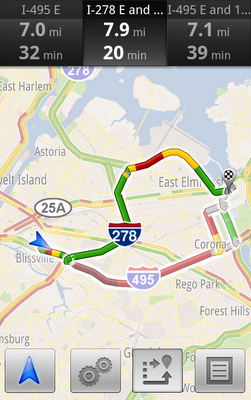
I must not be the only one to enjoy cruising at around 8 miles per hour above the speed limit, within the “tolerance” of what the highway patrol will allow before writing citations.  Since my first GPS, I greatly enjoy watching the ETA for my destination click off minute by minute as I make faster time than it’s calculation.   I have since converted to just using my Atrix 2 smartphone as my GPS, since the manufacturer of my GPS got short sighted and decided to charge for map updates.  Idiots.  So there is Google with a completely free, consistently updated product on a device I already have.

Google ingeniously just started taking in the GPS data of all connected smartphones and they were able to provide a very impressive up to the minute source of traffic information.  It is very accurate, but as I discovered over various weeks and trips of some distance, it is just not looking ahead.  It looks ahead on the road, telling you that over 100 miles away there is rush hour traffic, but it does not have the sense to look at past history and determine that  traffic is going to be gone before you arrive there.  The opposite occurs if you are an hour away from a high traffic area just before traffic begins.  You will watch in horror as your ETA starts getting block after block of 5-10 minutes added, and the route on your screen goes from solid green to yellow and then red.  As a result, it produces some wild swings, 30-60 minutes have happened to me several times, recently.

The solution is to use trends and break up areas into divisions to give an accurate calculation of traffic and what it will actually be when you get there.  It isn’t brain surgery.  First, divide the map into blocks, perhaps 5 miles by 5 miles or smaller.  The island of Manhattan is going to be heavily affected by traffic, and Cascade, Montana will not.  Once you establish where the traffic swings are and the degree to which they occur you can then assign a math value to the area as a whole, as opposed to trying to calculate and track every road in the country.

As an example of this, folks around New York City know that at 1am you can drive effortlessly across the George Washington bridge or the Lincoln Tunnel into NYC, but at 8 am, you are on a long parking lot.  There is an hourly trend, but there is also daily information.  It’s not the same on Saturday and Sunday as it is on Monday through Friday.  Daily is important, but then there is seasonal value that can be added.  There is a surge when college and school is in session, and there are a surge of people returning home at the conclusion of holiday weekends.  These are all easily tracked trends, with valuable math that can really give you trip planning.  Sure, there are abnormal construction delays and accidents, but as a rule, traffic could be easily tracked and planned for.

From this data, the next solution is adding time function to your trip planner.  Very simply, just plug in your starting and destination points and Google Maps will give you an average travel time, like it does now.  By adding the trending information, you will then be able to tell Google Maps when you plan on taking the trip and it can accurately tell you, for instance, that if you leave at 2pm on Thursday, it will take you 4 hours and 30 minutes and if you leave at 4pm on Thursday, it will take you 6 hours.
There is a difference.

So now I wait for the team of well funded engineers to think of this “amazing new feature” on their own.  🙂  Oh how I look forward to having money to toss at provisional patents in the future.

31 – Voicemail To Text Converter – Oct 22 2012

So you have called your friend, and they didn’t answer.  You know they don’t have the latest visual voicemail, and you don’t want to stick them with a voicemail, when a text is all that is needed.  There is a really simple solution for this.

You arrive at someone’s voicemail, and you hear their voice say, “please leave me a message and I’ll get back to you as soon as I can. you can also send me a text instead, by pressing 8”

“What is this?” you think to yourself, and press the 8.

Then the generic voice comes on and says, “please say your message at the tone and when you are finished, press the pound key”

You say your message, “this is Peter. if you want to hang out tonight give me a ring.” You press pound.

The computer voice then says, “here is your message” – (and then, still in the generic voice you hear he or she say) “this is Peter. if you want to hang out tonight, give me a ring. if this is correct press pound, if not, please press star.”

You press pound.

The generic voice then says, “your SMS text message has been sent”

The program converts voice to text, and then to demonstrate to you, the caller that the message is correct, it converts text back to voice, and states the message to you. This technology already exists, but as a voicemail option, it does not yet exist. I would contribute 300.00 to bring this idea to market.

30 – Automatic Call Screener – Oct 21 2012

One of the main reasons I chose to start this blog was the time stamp of my ideas that a blog like this provides.  Today’s idea stems from another idea from way back in the day, but with a twist it suddenly has new applications for today.  It was just after caller ID was brought online for everyone, and before the “do not call” list had been created.  My invention was a small box that would intercept incoming phone calls.  If the caller ID recognized the number on your list of friends / family it will just pass the call through and your phone will start ringing normally. (keep in mind, for home phone traffic, we usually have a short list that makes up 90% of all calls)  Now, if a call comes in and it is not recognized, the device will answer the phone, quietly for you on the first ring, and play the following message, “hello, the persons at this number do not accept calls for solicitation of any kind.  if you are a solicitor please hang up now.  To confirm you are not a solicitor, please press 5” (this would be a randomly generated number).   After sensing the appropriate tone, the device would then connect the outside call to the house phones and they would start to ring normally.  The residents would know that the phone ringing was not a solicitor and there would be more comfort in picking up the phone.  If the caller was to hang up or not press the correct key, then the call would be terminated and the resident would never be bothered. This whole process would occur silently.

This would eliminate nonsense calls.  For those aggressive types there would be a hotline to call and complain, and official and wide reaching complaints would be able to be leveraged against certain firms that can’t take no for an answer.  For each complaint brought against a telemarketing firm, there would be an opportunity for press coverage to this device that wars against the evil telemarketers.

That was around 20 years ago.  Another example of me taking an idea to someone I thought on the cutting edge, and they shot it down as a tough sell.  Over 10 years later it got so bad the government had to step in with a do not call list.  Another opportunity missed.  Oh well, lesson learned. Certainly in 2012, there is a smaller need for such a thing but for those with landlines, there is still a value and function to it.  It still could be easily built and sold for less than $20 and would be well worth it, but now I have a new twist for it that adds more value to all.

Looking at yesterdays idea of the voicemail system built into your phone, you could easily add this into the add as a feature.  Automated call screening with response requirements.  I still occasionally get calls from nonsense people, or bots that actually try to put me on hold when I pick up.  If they were given that same anti-telemarketer message, and required to hit a particular, randomly generated number, it would eliminate the nonsense calls and again, could all be handled quietly by the smartphone.

You could really add a host of applications to this process.  “I’m taking a nap, please leave a message, but if it’s an emergency, press 9.”  Now you can go to take an afternoon nap, turn your phone to silent and know that it won’t ring unless someone thinks it’s an emergency, and even then you can still see the call ringing and opt out of answering it.  (“i don’t care what they are going to say to me, even if they think it’s an emergency”).  The applications are many.  Eventually, the ability to press a particular key and be then connected, will be a feature offered by the carrier.  That is inevitable, but putting it right on the phone, we can make it a reality today.

29 – Voicemail Processed On Your Phone – Oct 20 2012

There is an obvious need and advantage to having your carrier handle your voicemail.  Here in 2012 we still have terrible spottiness in our cell coverage.  Voicemail allows us to provide a message to the caller we miss and also to take the message from the caller if they decide to leave one.  That’s great.  I would say without a doubt we will always want to use the carriers, freely provided voicemail, but… I think we should also have another option.  An option, provided by a simple app, that would have tremendous novelty value, and may prove invaluable in certain situations.

Voicemail on your phone.  The call comes in.  We see it, but don’t want to answer just then, or maybe we don’t want to answer that person at all.  Apples IOS 6.1 is going to allow for customizable voicemail with the carrier, so we can have specific messages for specific people, which certainly adds value, but doesn’t adapt to your specific situation at the time.  What if you could push a button, and the phone would answer for you, take the message, and store it all on your phone?  What if you could just easily retain messages this way as mp3 files on your phone?  Have you ever tried to save that certain message of your baby’s first voicemail or perhaps a special birthday message from a group of friends?  Proven the value yet?  What if you could put that caller on speaker whilst they left the message?

OK, now if you have your mind around the possibilities of this device, what if you could screen a call to send the person to voicemail, and then when you hear them perhaps confess their undying love, you have the ability to cut in and pick up the call.

Yep, sometimes it’s good to go backwards in time to take a concept forward.  The technology exists to make this a reality today, it’s just a matter of someone writing the app.  I’m in on this one for 500.